 Thomas MarcelleCEO & Co-founder
We're Naano, the marketplace where B2B brands like Fireflies, Synthesia, Attio and lemlist book posts from creators on LinkedIn and X. This playbook is what we learned running those campaigns, plus the best public examples we could find.
TL;DR Your company page reaches people who already know you. Creators reach the 95% of buyers who don't, and those buyers trust them more than your ads. The B2B brands growing fastest right now don't book one random post. They pick one of the 6 plays below, run it, and repeat it until it stops working.
- $5M ARR: Postiz, built on X articles quoted by paid creators
- 1M+ views: Fireflies' launch with 87 creators, via Naano
- $1.1M of pipeline: Vector, from $12K and 7 creators
- 79 vs 1: median quotes on the best vs the worst B2B launches on X
Public examples are sourced at the end. Only Fireflies is a Naano customer.
Free 30-minute call with Thomas, founder of Naano: plan your next launch with creators. Book a call →
You should read this if you sell B2B software and you have something coming: a launch, a webinar, a big feature, a quarter where ads got too expensive. You should not read it if you're hoping one viral post will save the quarter. None of this is one post.
Which play should you run?
| If… | Run |
|---|---|
| You're launching something | Play 2, then Play 1 the week after |
| You have a result or a method worth telling | Play 1 |
| You want emails, not just views | Play 3 |
| You want buyers to remember you next quarter | Play 4 |
| You have a webinar, an event or a live demo | Play 5 |
| Some creator posts already work | Play 6 |
Before any play: pick creators for their audience, not their follower count
Every play below depends on one choice: who posts. We looked at 469 sponsored LinkedIn posts booked on Naano and compared what they cost with how many people saw them.
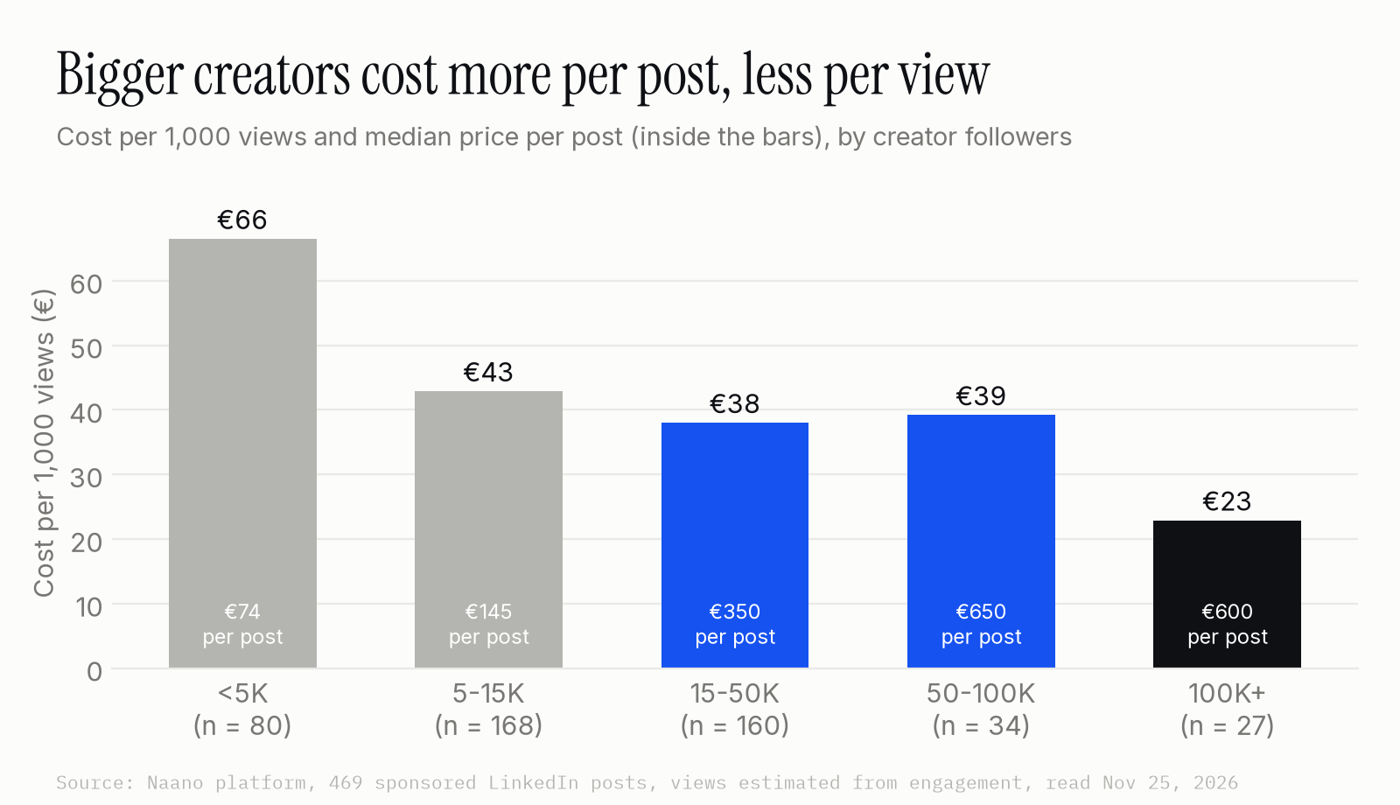
- Big accounts cost more per post, less per view. A median post costs €74 under 5K followers and €600 above 100K. But per 1,000 views, the big accounts are the cheapest: €23, against €66 for the smallest.
- 15K to 50K followers is the sweet spot for most B2B brands. €350 a post, €38 per 1,000 views, and they reach about a third of their followers. Accounts above 100K reach about 13%.
- Text-only posts are the most expensive views (€52 per 1,000). Images come in at €36, video at €44, and carousels at €19 on a small sample of 13 posts.
The mix that works: 3 or 4 big accounts for reach, and a larger group of 15K–50K creators whose audience is exactly your buyers, for the comments and the credibility. Then judge everyone on results, never on followers.
Play 1: Write one article. Pay creators to quote it.
Case: Postiz, from $2M to $5M ARR. Best for: a result or a method worth telling. Set up: 1 week. Watch out: label every paid quote.
Nevo David runs Postiz, a social media scheduler. No VC, no sales team. In August he published an X article called "Postiz crossed $2M ARR while everybody says SaaS is dead". It did 209K views and 2,216 saves. Four months later he posted "Postiz reached $5,000,000 ARR!! We added $2M ARR in one month."
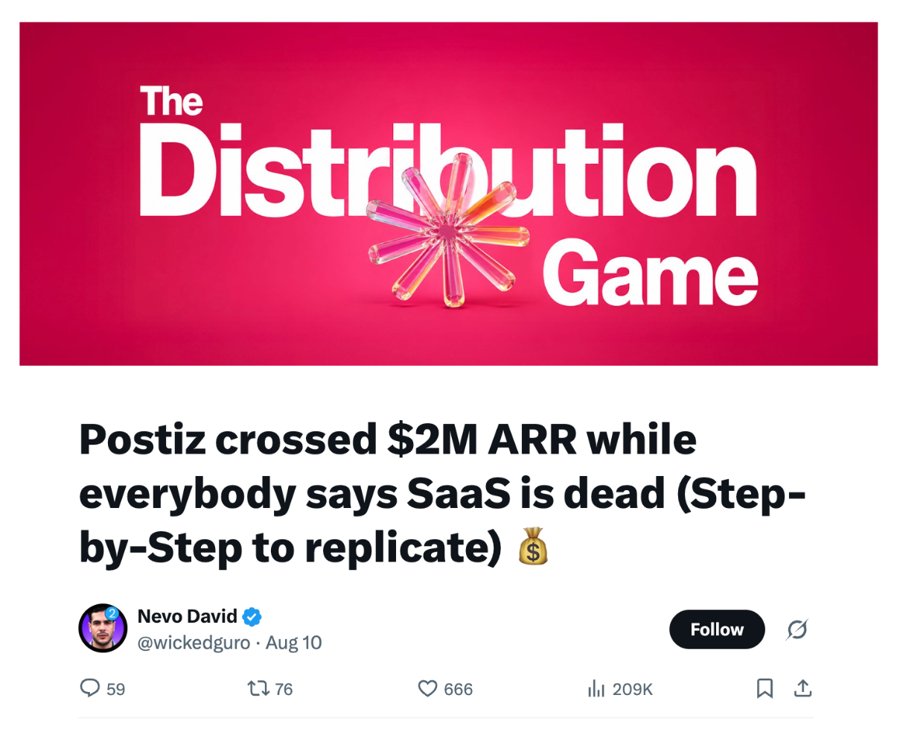
The article: the result is the title, the product is one step inside the process.
He explains the engine in that same article, in one sentence:
"I pay influencers to quote-repost the article (with the paid promotion tag, of course)." Nevo David, founder of Postiz
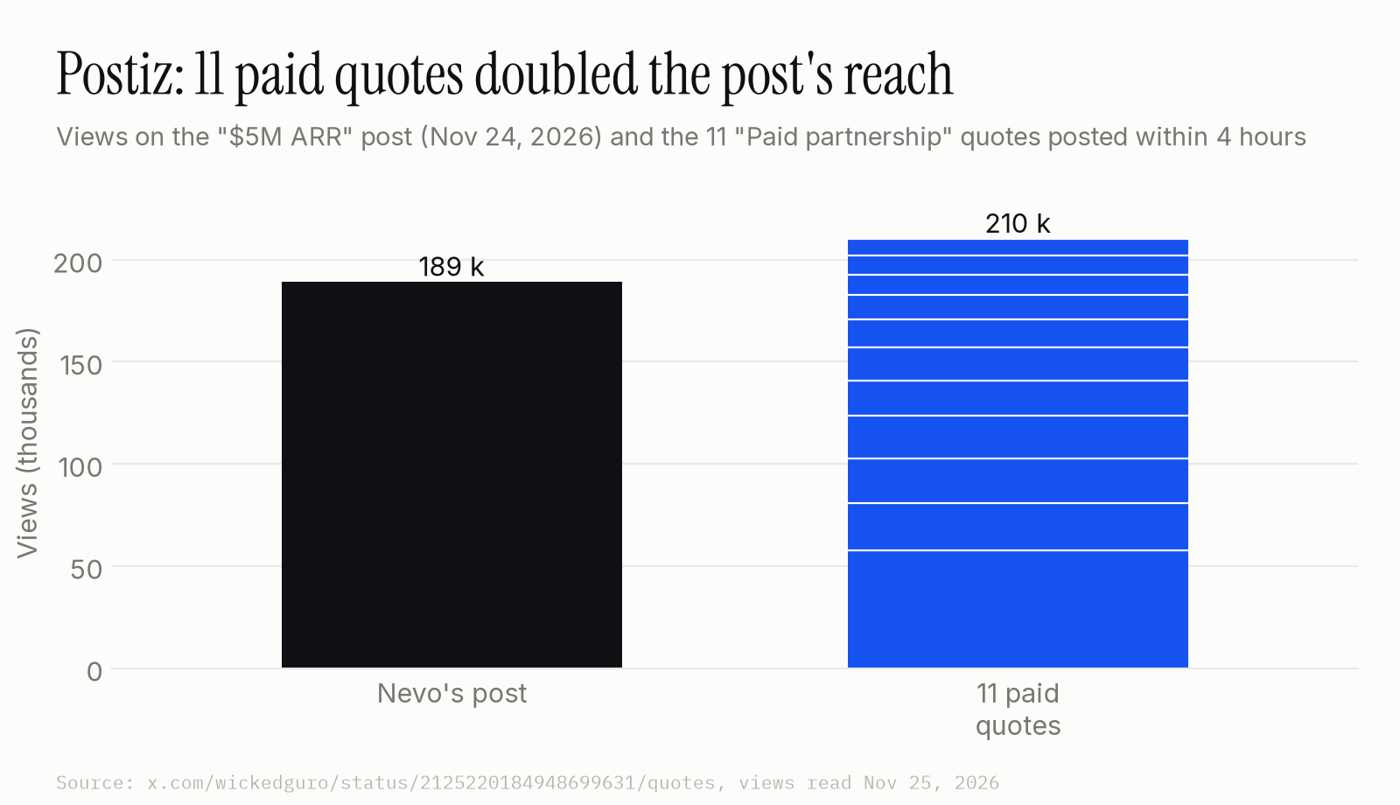
We checked it on his $5M post. Within 4 hours, 11 creators quoted it with the "Paid partnership" label, in three waves: 32 minutes after, around 1h30 after, around 2h30 after. Together, those 11 quotes pulled ≈210K views, more than the post itself (189K).
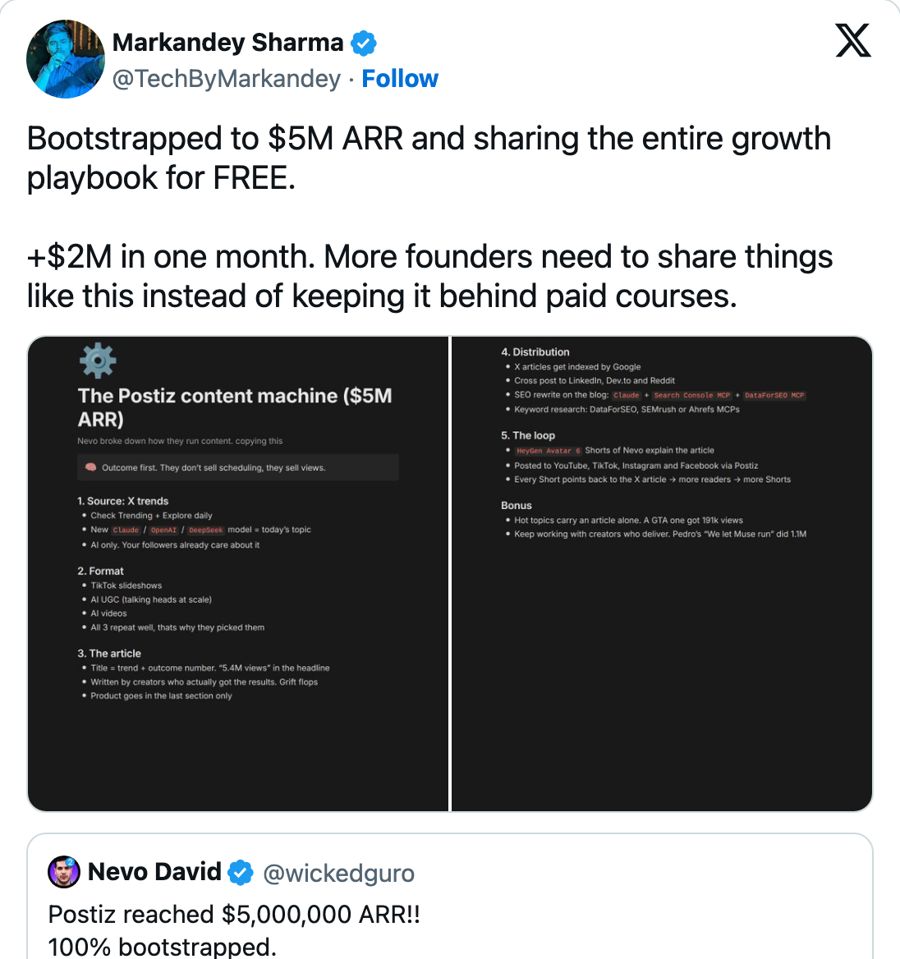
One of the 11 paid quotes: 57K views on its own. The creator turned Nevo's video into his own one-page summary. See the post.
Then nothing is wasted. Every article becomes an SEO blog post and a few short videos that send people back to it. He even open-sourced the process.
How to run it
- Write a how-to, not an announcement. The result in the title ("how we got X"), your product as one step. X rewards saves and read time, so give people something worth saving.
- Publish it natively, as an X article or a LinkedIn article. Both networks bury links to your blog.
- Book 5 to 20 creators to quote it, each with a line of their own, each with the "Paid partnership" label.
- Stagger the quotes in waves over the first hours, then a few more over 3 days.
- Recycle it into a blog post, a LinkedIn post and a 30-second video.
On Naano: Fireflies ran this play on X for its launch on November 11. Creators quoted the launch post with their own take on "why Fireflies now": 33 quotes and 4 posts on X, 314,752 views at a €14 CPM.
Don't overdo it. Higgsfield says it paid more than 10,000 creators $800K in three weeks. Its X account was then suspended, with no public reason from X. Label every paid quote and keep the volume human.
Play 2: Launch with 50 creators in the same 24 hours.
Case: 767 launches on X, Codos, Fireflies. Best for: launches and big releases. Set up: 3 weeks. Watch out: a small wave does nothing.
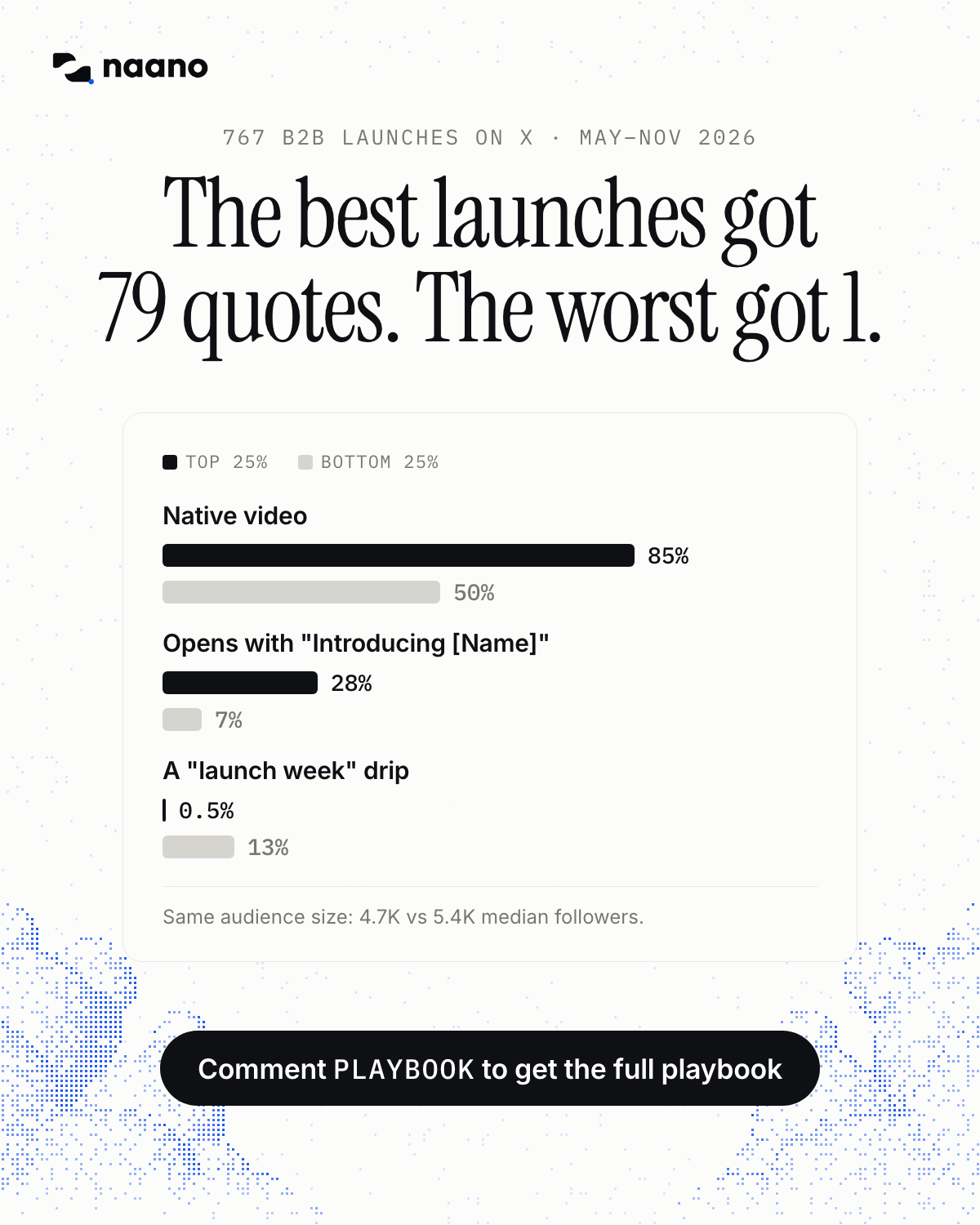
We pulled 767 B2B, AI and dev-tool launches posted on X between May and November 2026, and scored each one against what the account's size should have produced. The winners didn't have bigger audiences: a median of 4.7K followers at the top, 5.4K at the bottom. What they had was other people.
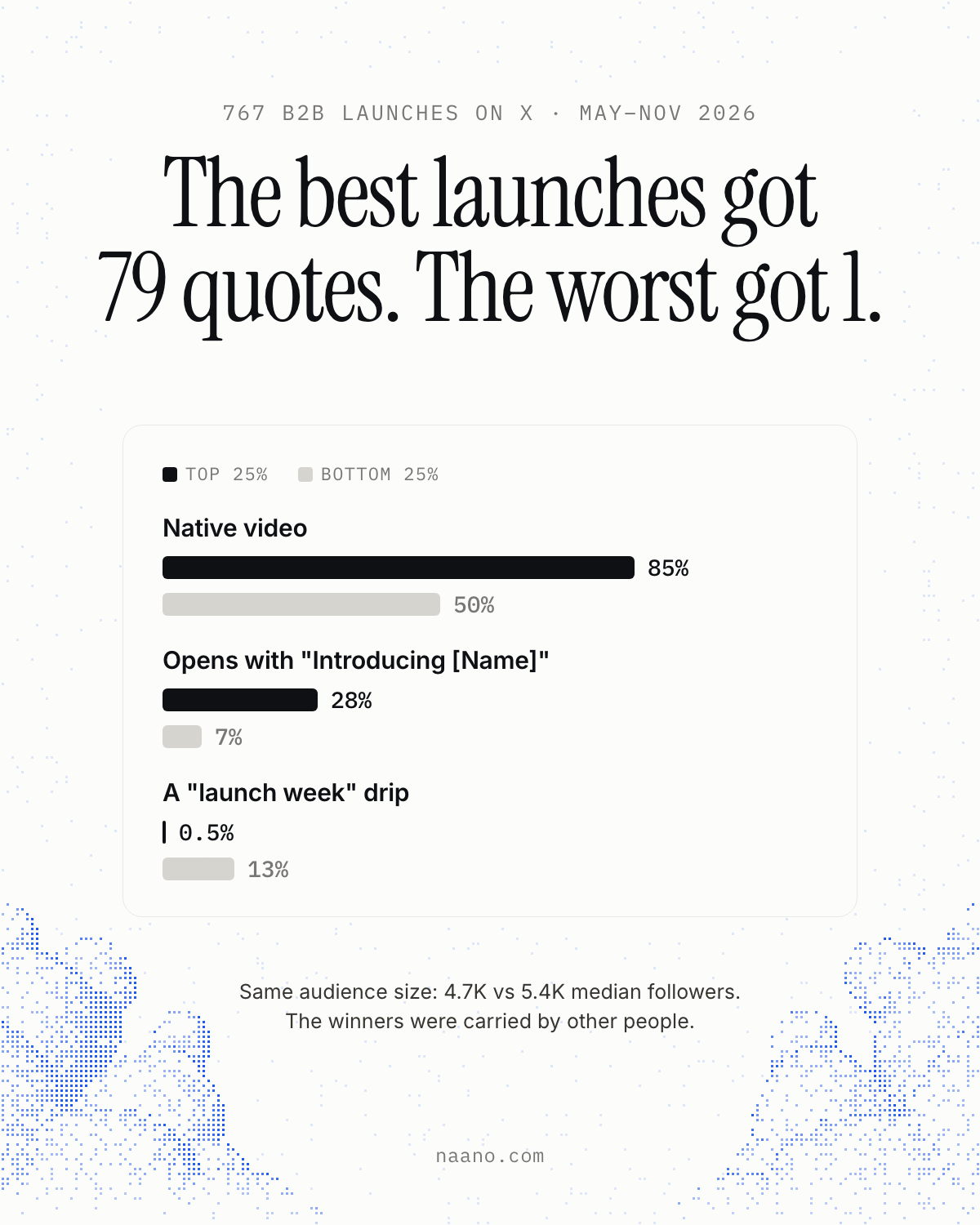
The best launches got a median of 79 quotes. The worst got 1. The rest follows from that: 85% of the top launches had a native video (50% at the bottom), 28% opened with "Introducing [Name]" (7% at the bottom), and almost none were a "launch week" drip.
Here's what being carried by other people looks like:
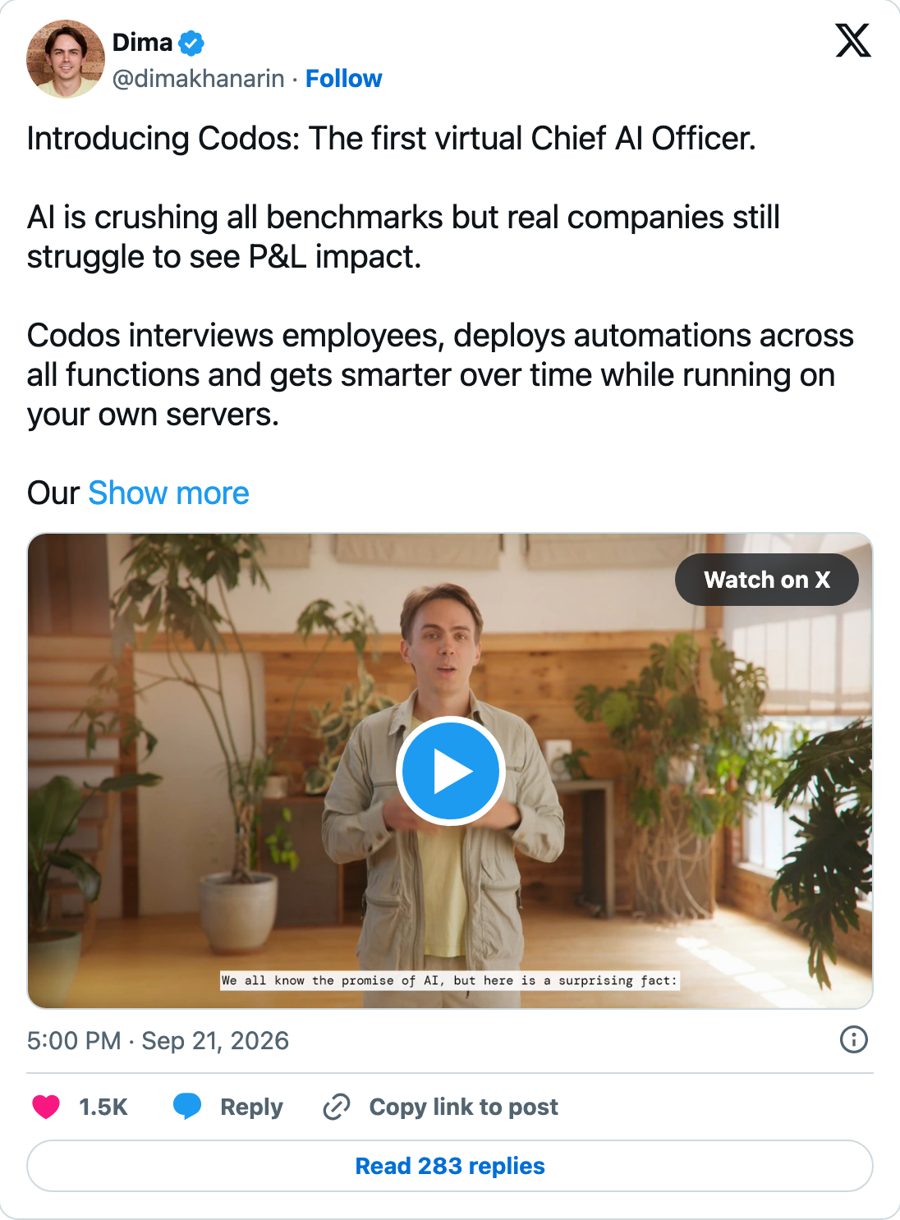
Codos: 1.64M views from a founder with ≈1,800 followers, pushed by founders and creators close to enterprise buyers. See the post.
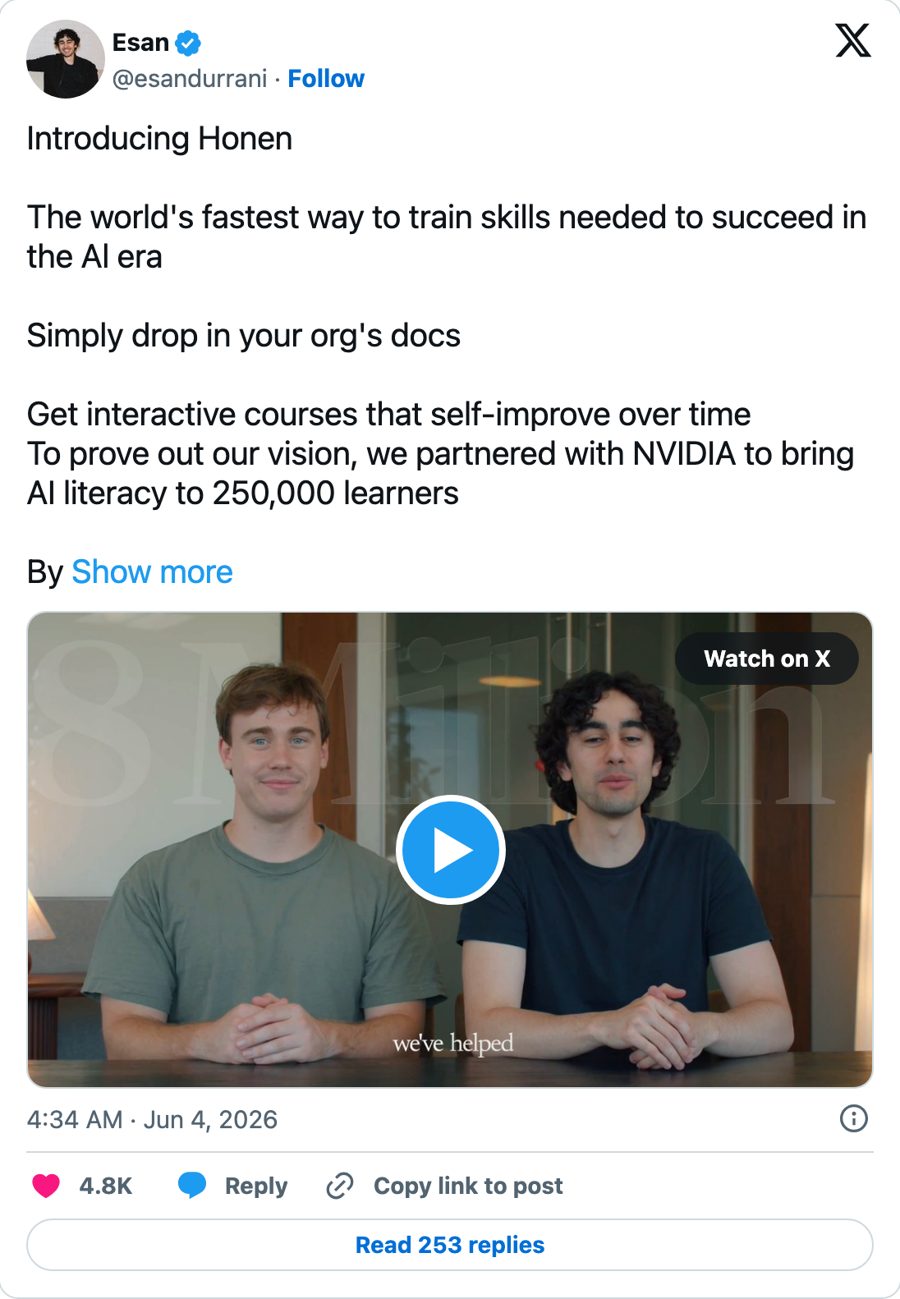
Honen: 5.5M views from a 2.8K-follower account. Video, "Introducing", and an NVIDIA partnership in the post. See the post.
On Naano: 1M+ views. That's what Fireflies' launch of Fred did on LinkedIn and X: 87 creators, 110 posts and quotes, 51 of them in the first 24 hours, each with a different angle (AI-stack lists, infographics, reaction videos, X quotes).
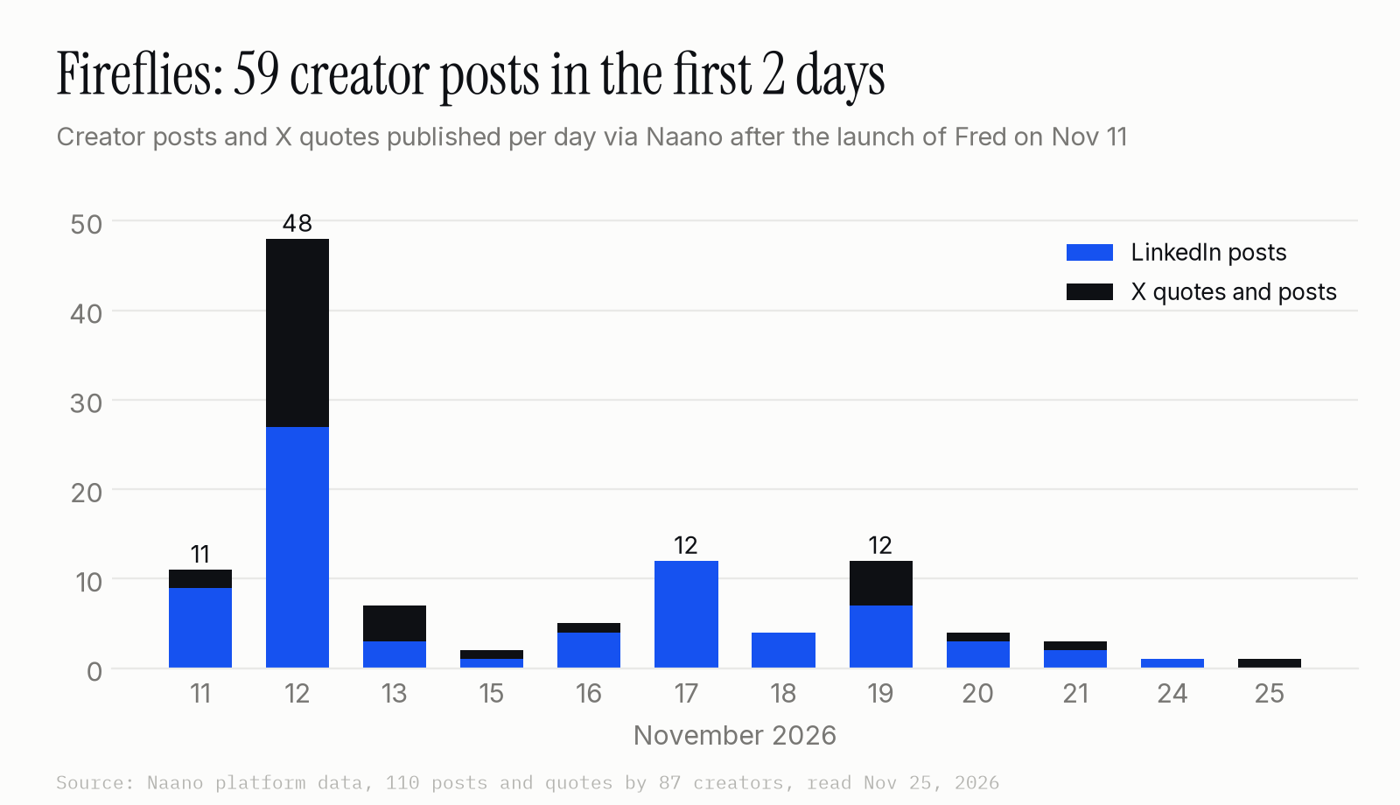
The posts that worked best weren't feature announcements. They were lists people could check against their own stack:
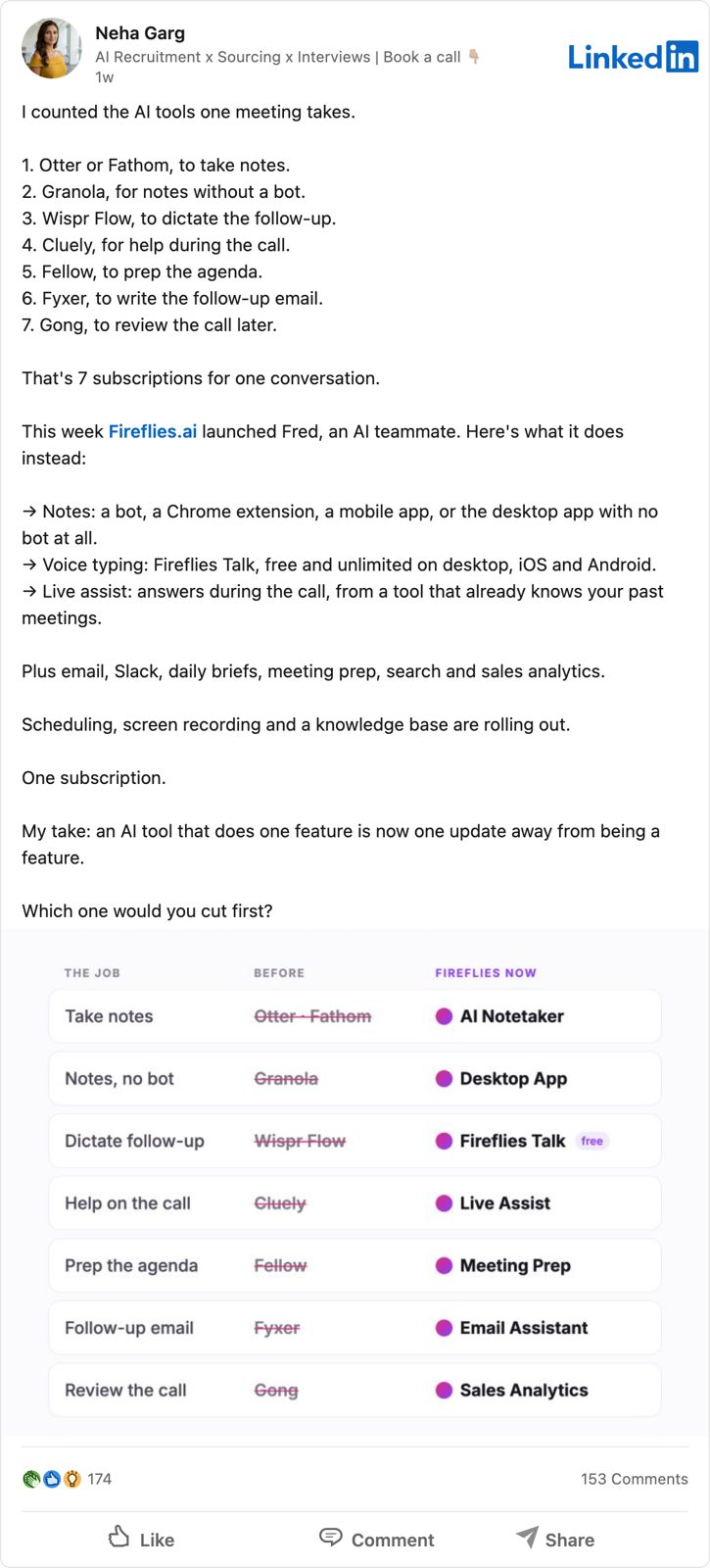
"I counted the AI tools one meeting takes": 153 comments, ≈24K views, from a 12.7K-follower creator. See the post.
The timeline
| When | What |
|---|---|
| 3 weeks before | Shortlist 40 to 80 creators. Pick 4 or 5 angles. |
| 2 weeks before | Book them, one angle each. Never the same text for everyone. |
| 1 week before | Drafts approved. Launch video ready, 1 to 2 minutes. |
| Launch, hour 0 | Your post: "Introducing [Name]" with the video. |
| Hours 0 to 24 | Creator posts and quotes go live. |
| Days 2 to 10 | A second, smaller wave for everyone who missed it. |
A small wave does nothing. Higgsfield's "Playable" launch got 6 creator posts in 4 hours: ≈21K views combined, against ≈72K for the brand's own post. Volume and different angles are what move a feed.
Launching soon? Book a free 30-minute call and we'll build your launch-wave plan with you.
Play 3: Give away something worth an email.
Case: Fireflies, B2Linked. Best for: collecting emails, not just views. Set up: 1 week. Watch out: keyword in the image, not the text.
Views don't fill a pipeline. Emails do. The fastest way to get them from LinkedIn is still the oldest: a creator offers something genuinely useful, and readers ask for it.
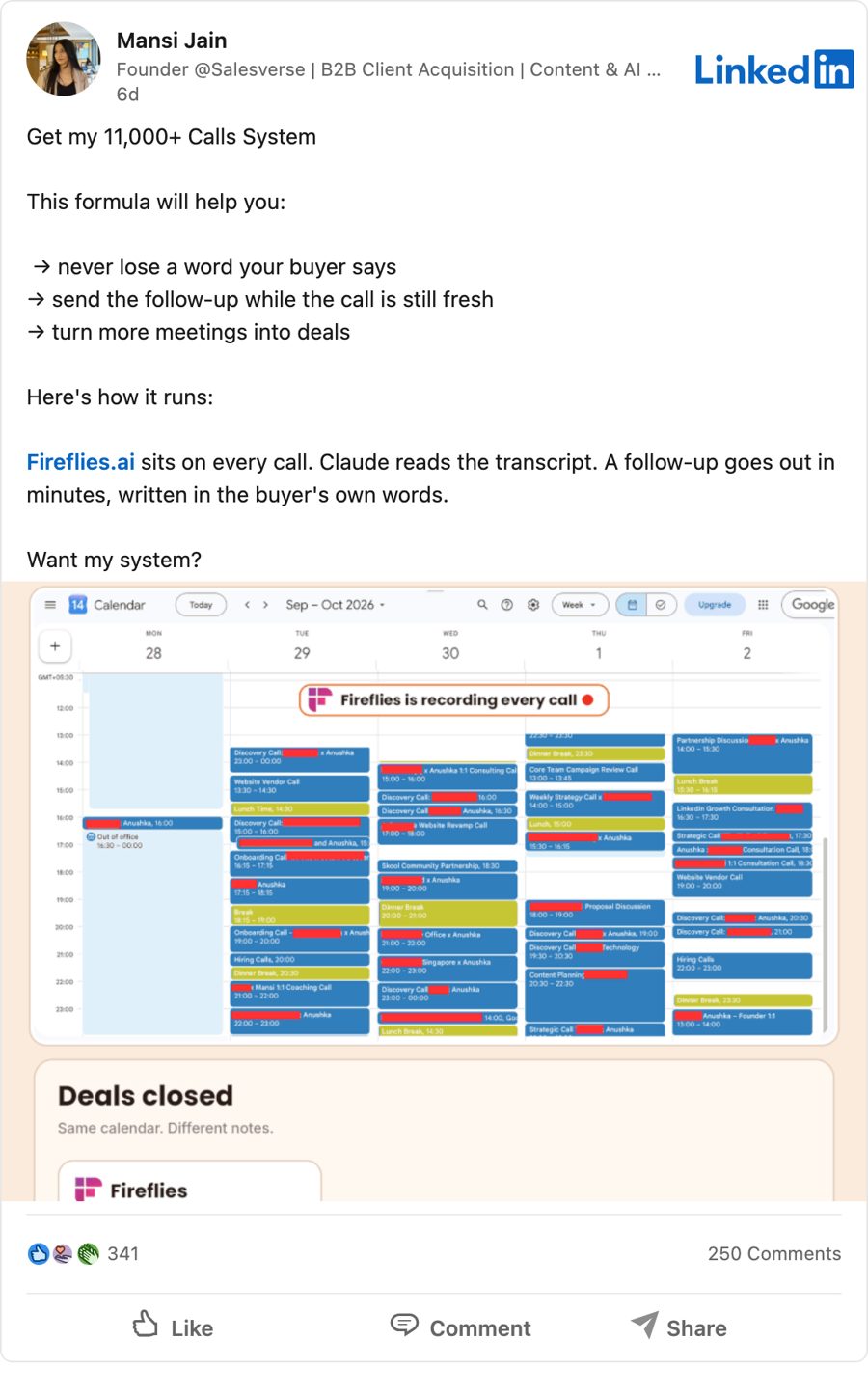
For Fireflies, via Naano: "Get my 11,000+ Calls System". 250 comments, the most of the whole campaign, from a 26.8K-follower creator. See the post.
B2Linked, a LinkedIn ads agency, offered its advanced LinkedIn ads guide to anyone who commented on one post: 2,427 comments, over 1,000 guide requests, and 126K+ views on an account that usually gets around 10K. The founder's estimate for a normal landing page: about 30 downloads (B2Linked).
It works because the reader does the work. On Naano, sponsored posts that offer something for a comment get 0.92 comments per reaction, against 0.53 for the others.
The 2026 version
One thing changed this summer: posts that ask for comments in the text got throttled. MagicPost measured −52% impressions on "comment KEYWORD" posts after July 27, 2026 (684,000 posts). The fix is simple: move the keyword out of the text.
How we launched this playbook: the offer and the keyword live in the image, the text tells a story, the link sits in the first comment.
- Pick a resource worth an email: a template, a system, real data. Tied to your product, never a brochure.
- Lead with the result, not the gift. "11,000+ calls" beats "free template".
- Put the keyword in the image, the link in the first comment.
- Gate it behind a 2-field form with one tracked link per creator.
- Send the DMs by hand, in batches. Automated comments are banned on LinkedIn, and on X don't do it at all.
Want these plays applied to your company? 3 quick questions, then a free 30-minute call with Thomas. Book a call →
Play 4: Same creator, once a month, for 3 months.
Case: Vector, $12K into $1.1M of pipeline. Best for: being remembered next quarter. Set up: after one test post. Watch out: re-book on results only.
One post gets seen and forgotten. Vector, a B2B software company, booked 7 creators (3 customers and 4 people its buyers follow, ≈13K followers on average) for one post a month, three months in a row. Budget: $12K. Pipeline over the period: ≈$1.1M, according to its VP Marketing, Jess Cook (Favikon).
The detail that says it all: under the third post, a reader commented that he had never heard of Vector. Two posts weren't enough. That's the point of repeating.
Why it works: at any moment only about 5% of B2B buyers are in market (LinkedIn's B2B Institute). The other 95% will buy later, from a name they remember. And 90% of decision-makers say they're more open to companies that share expertise regularly (Edelman and LinkedIn, 2024).
On Naano: the same creator posting a second time for the same brand gets 35 median reactions instead of 26. The few who went to a 3rd and 4th post did even better.
Pick on results, not on followers. In HubSpot's creator program, 18 of 62 creators posted 3 times or more. One climbed to 1.3× her usual engagement by her 3rd post. Another stayed at 0.1 to 0.3× for 6 posts in a row. Test first, then sign the ones who delivered.
Play 5: Fill your webinar with someone else's audience.
Case: Sprinklr, ≈5,000 registrations. Best for: webinars, events, live demos. Set up: 3 weeks before the date. Watch out: half of sign-ups don't show.
Sprinklr built a masterclass with four creators marketers already follow: Jay Baer, Ann Handley, Mari Smith and Paul Roetzer. They promoted it to their own audiences. ≈5,000 registrations across 4 regions, 23.4M reach, ≈100K engagements on the creators' posts, and a season 2 the year after (TopRank).
HubSpot sees the same at INBOUND: creators covering the event got 0.87× their usual engagement, against 0.27 to 0.65× for product posts, at the lowest cost per engagement of the whole program.
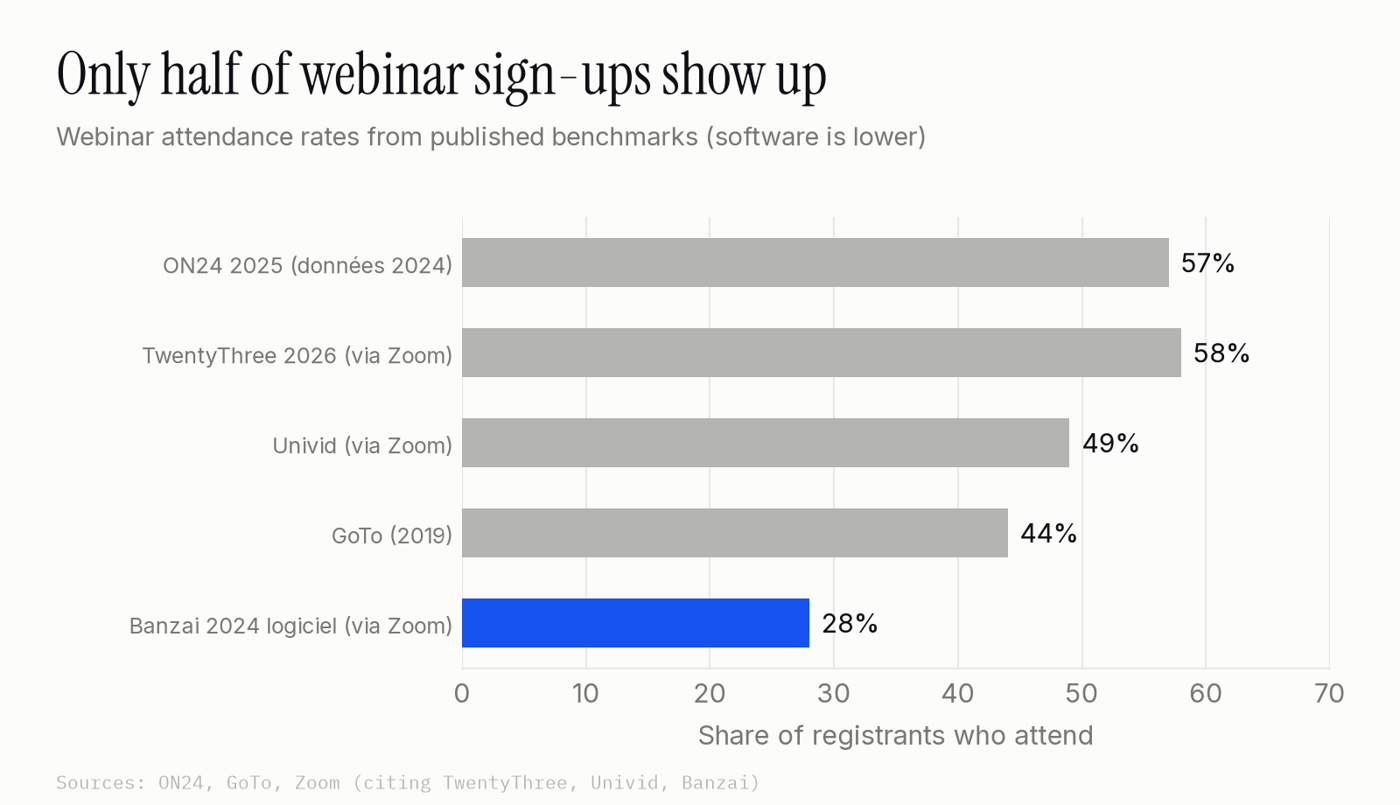
One number to plan around: only about half of registrants show up, and in software it can drop to 28%. Book the creators for the reminder too, not just the announcement.
How to run it
- Make 1 or 2 creators speakers, not just promoters. They talk about it longer and better.
- 3 to 5 creator posts in the 10 days before, each about a problem the event solves. Link at the end, never in the first line.
- One last reminder the day before.
- One tracked registration link per creator.
- After the event, a short clip from the creators, with the replay behind a form.
On Naano: before a live demo in October, a sales software brand booked 5 creator posts. The one that opened with a strong opinion ("80% of SMBs don't need a CRM") got 7,608 views on its own. The other four got between 631 and 1,625.
Play 6: Turn the best creator posts into ads.
Case: Snowflake, 21.2% CTR. Best for: scaling posts that already work. Set up: 48 to 72 hours after posting. Watch out: get the creator's OK upfront.
Once a creator post works organically, put money behind it. LinkedIn lets a brand sponsor a person's post (an employee or a creator, with their OK) and show it to the exact accounts it targets. LinkedIn says these Thought Leader Ads get 2.3× the click-through rate of standard image ads. Snowflake sponsored a developer advocate's post for its Dev Day: 21.2% click-through rate, 40 target accounts registered (LinkedIn).
- Post organically, then wait 48 to 72 hours.
- Keep the top 10 to 20% by comments and clicks.
- Sponsor those, targeted at your account list or the exact job titles you sell to.
- Cut what doesn't click after 7 days.
On Naano: managed campaigns include the ads on top of the creator posts. Boosting a post yourself from the platform is in pilot with a few brands for now.
Measure it: what to look at, and what to ignore
- Views per creator, not only the campaign total. That's how you know who to re-book.
- Cost per 1,000 views, to compare creators of different sizes on the same scale.
- One tracked link per creator, so clicks and sign-ups land on the right name.
- Who commented, not how many. Job titles in the comments tell you if the audience is your buyers.
- Read the numbers twice: at 72 hours and at 7 days. On LinkedIn, posts keep spreading for days.
- Ignore follower counts and likes on their own. They tell you nothing about who saw the post.
5 mistakes that kill B2B creator campaigns
- Scripting the creator. Their audience reads it in two lines. The paid quotes that worked for Postiz each had the creator's own angle.
- Sending everyone the same text. Fireflies gave each creator a different angle. That's why 110 posts didn't look like one ad repeated.
- Booking on follower count. On Naano, the smallest accounts cost about 3 times more per view than the biggest. Pick on who reads them, then on cost per view.
- Thinking in single posts. Under Vector's third post, a reader had still never heard of them. Plan for repetition from day one.
- Launching with a handful of creators. Six posts in four hours did ≈21K views for Higgsfield's launch. Volume is the play.
What to do this week
- A launch coming? Start Play 2 now. Three weeks before is earlier than you think.
- A result worth telling? Turn it into an article and have 10 creators quote it (Play 1).
- A template or a system? Make it the lead magnet, keyword in the image (Play 3).
- Already ran creator posts? Re-book the 2 or 3 who delivered, once a month for 3 months (Play 4).
- Once something works, don't get creative. Repeat it until it stops working.
We built Naano because running these plays by hand means hundreds of DMs, spreadsheets and invoices. On Naano, B2B brands find creators on LinkedIn and X, book posts, reposts and quotes, and line up a launch wave, all in one place.
Want this applied to your company? Book a free 30-minute call with Thomas, founder of Naano. You leave with your plan, the creators to book and a budget.
FAQ
What does a sponsored LinkedIn post from a B2B creator cost?
On 469 sponsored LinkedIn posts booked on Naano (read November 25, 2026), the median post cost €74 from creators under 5K followers, €350 between 15K and 50K, and €600 above 100K. Per 1,000 estimated views, the biggest accounts were the cheapest at about €23, against about €66 for the smallest.
How do B2B brands launch with creators?
They book 40 to 80 creators two to three weeks before launch, give each one a different angle, and have them post or quote the launch within the first 24 hours. In a Naano analysis of 767 B2B, AI and dev-tool launches on X, the best launches got a median of 79 quotes from other accounts and the worst got 1.
Do 'comment KEYWORD' lead magnet posts still work on LinkedIn?
They still collect comments, but a MagicPost study of 684,000 posts found that keyword posts went from +9% impressions to -52% after July 27, 2026. Putting the keyword in the image and the link in the first comment keeps the mechanic without the throttled text.
Can you sponsor a creator's LinkedIn post as an ad?
Yes. LinkedIn Thought Leader Ads let a brand sponsor a member's post, with their approval, to a targeted audience. LinkedIn reports 2.3 times the click-through rate of standard image ads.
Sources
- Naano data: Naano platform, read November 25, 2026. LinkedIn views are estimated from public engagement; X views are public counts.
- 767 launches: Naano analysis of public launch posts on X, May 1 to November 23, 2026, scored against account size. Correlations, not causation.
- Postiz: $5M ARR post, its quotes, $2M ARR article, Stripe-verified MRR (third party). Revenue is founder-reported.
- Higgsfield: PiunikaWeb, Aliteq.
- Launches: Codos (agency case study), Honen.
- Lead magnets: B2Linked, MagicPost study, LinkedIn content guidance, LinkedIn on automated comments.
- Ambassadors: Vector, HubSpot, 95-5 rule, Edelman × LinkedIn 2024.
- Events: Sprinklr, ON24, Zoom, GoTo.
- Ads: LinkedIn, Thought Leader Ads, Snowflake.
CEO & Co-founder
Thomas Marcelle, CEO and co-founder of Naano, the B2B creator marketplace started in Paris in 2025, writes about creator-led growth and founder-led sales.
Ready to try it
Run a creator-led growth campaign on Naano.
Book B2B creators at the fixed price each one sets, compare eligible creators and track campaign outcomes. Naano Pro is €300 ($350) a month.